Data, methodology, open collaboration

For Researchers

Methodological details, instruments, and an invitation to collaborate on multilingual stuttering research.

Our data

We are building one of the largest bilingual speech databases of stuttered and non-stuttered samples, spanning 8 languages and Hebrew.

EnglishHebrewRussianYiddishFrenchArabicAmharicSpanish

What you gain by collaborating with us

We welcome clinicians and researchers to collaborate with us on our projects. Collaboration includes, but is not limited to, the items below.

1

Opportunities to co-author publications

  • Inviting children who stutter to participate in our studies
  • Co-authorship in our publications (after discussing the details with Sveta Fichman or Dvora Freud)
  • Use of our materials
  • Developing new ideas for research projects
2

Access to our assessment and study materials

To assess children's communicative abilities in children who do and do not stutter we use the Overall Assessment of the Speaker's Experience of Stuttering (OASES; Yaruss & Quesal, 2006, translated to Hebrew by Sveta Fichman). OASES-S (school children) and OASES-T (teenagers) are used with children who stutter, and the Speaking Ability versions (OASES-SA-S and OASES-SA-T) are used with children who do not stutter.

We adapted materials to collect speech samples using Frog story books. Pictures and scripts are culturally adapted to each bilingual group, and all materials are adapted for Haredi children.

3

Early access to the most recent empirical findings

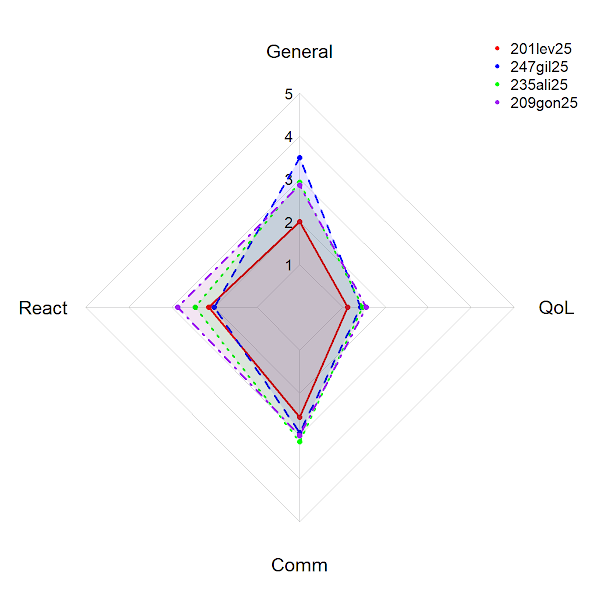
The figure shows OASES scores in four sections for four children who stutter: general knowledge about stuttering (General), reactions to stuttering (React), communication in different situations (Comm), and quality of life (QoL). The 1–5 scale: 1 represents minimal impact of stuttering and 5 signals high negative impact. The figure shows high individual variation for the General and React sections.

Early access to the most recent empirical findings

Tools we use