Loading…
A practical hub for speech-language pathologists working with monolingual and bilingual children who stutter.
Our research lab is dedicated to understanding how stuttering manifests across different languages and whether observed disfluent behaviors truly align with a child's inner communication attitudes. By bridging these clinical and linguistic perspectives, the results of our studies are expected to directly improve the assessment, diagnosis, and treatment of stuttering, while reshaping how the general public understands this complex disorder. To achieve these goals and translate this science into everyday practice, we need your unique expertise and collaboration.
It's simple: Share our study invitations with the parents of children who stutter in your clinic or network.
Every single participant helps us unravel the multidimensional nature of stuttering. Your collaboration doesn't just advance academic theory—it directly fuels the development of more precise, culturally sensitive assessment tools and evidence-based treatment strategies that will ultimately benefit your clinical practice and the families you serve.
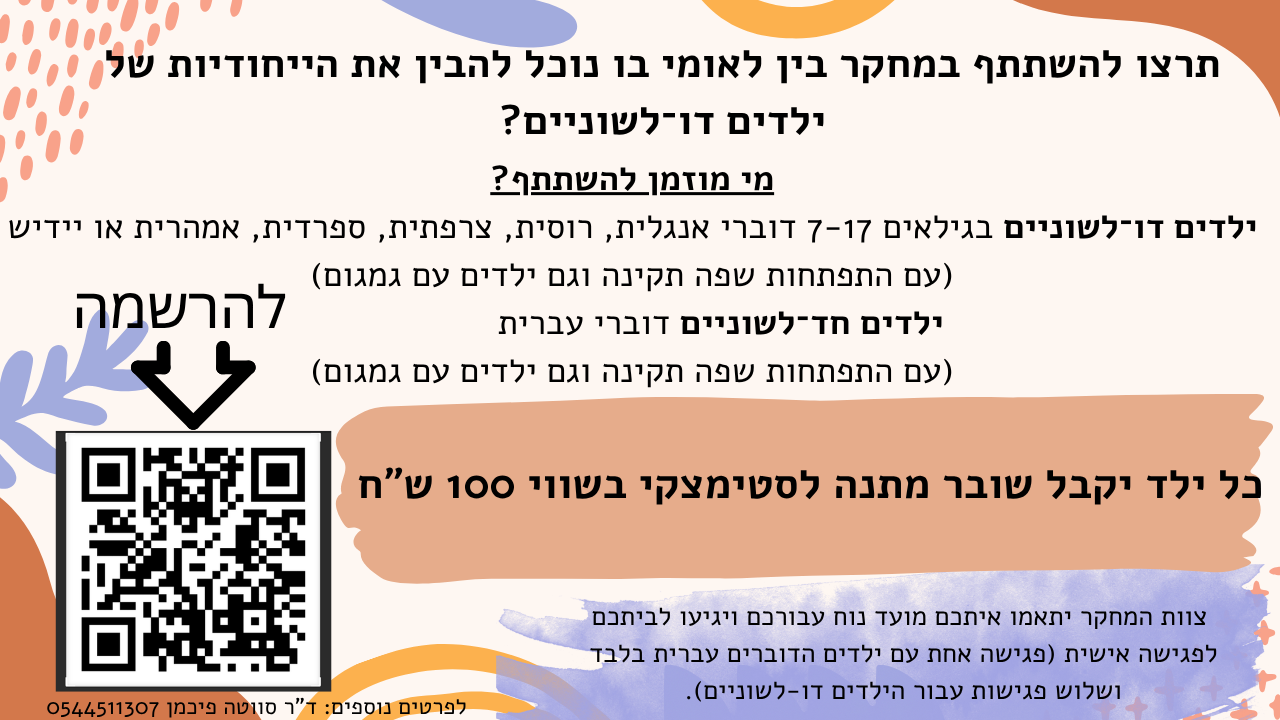
Download Recruitment FlyerDr. Sveta Fichman on our new stuttering project, led together with Dr. Dvora Freud.
0:00Dear speech-language clinicians, hello.
0:04My name is Dr. Sveta Fichman, and we have a new project on stuttering — together with Dr. Dvora Freud.
0:11We have many questions about the assessment of stuttering in every child,
0:16especially in children who speak more than one language at home.
0:21We will understand whether stuttering changes — whether the child speaks the home language or Hebrew —
0:28and also whether stuttering affects children's quality of life.
0:35We are building a new project with engaging tasks and a gift for every child — supported by the ISF.
0:44We can only learn about assessment if we have opportunities to meet with children —
0:52and this is where we need your help.
0:55We ask that you tell families about the project and invite children to participate.
1:01Only this way can we improve assessment and our overall understanding of stuttering.
1:08You can contact me freely —
1:12I will attach a phone number and a link where any parent can register and take part.
1:18So how does it work?
1:21After a parent fills out the form at the link,
1:27research assistants — students in Communication Disorders — set a time and place convenient for the family.
1:34We'd be very glad to cooperate. Goodbye.
We welcome clinicians and researchers to collaborate with us on our projects. Collaboration includes, but is not limited to, the items below.
Opportunities to co-author publications
Access to our assessment and study materials
Early access to the most recent empirical findings
We collect speech samples using three procedures: spontaneous speech, narrative retelling, and narrative generation. We meet bilingual children in three separate sessions: one in the home language, one in Hebrew, and one in which the two languages are spontaneously mixed (translanguaging). Narrative data are elicited using wordless picture books from the Frog story series (Mayer, 1969).
The wordless picture books we use to elicit narratives — from the Frog story series (Mayer, 1969).